
Oh technology
Oh technology · Temporal determinism

Human behaviour is finite. So it can be computed.

Most of what people do, they have done before. We compute it against published outcomes. Our first market is film and TV: the streaming views behind over 128,000 titles, in 20 markets and 34 platforms.

U = f(En, El, Pb, P | Π)

  • As of October 2026
  • 292.85Bviews computed, across 45 months
  • 128,000+film and TV titles
  • 20markets, since January 2023
  • 34streaming platforms
  • 202sources of published ground truth
What we do

First, entertainment.

We compute the streaming views behind film and TV, anchored to what platforms themselves publish: one number both sides of the table can check.

Live
OhTalent

For actors, directors, writers, producers and composers

See the computed streaming views behind every title you worked on.

  • Every title, not just the hits, period by period
  • 20 markets and 34 platforms, since January 2023
  • Over 128,000 titles and 850,000 people
Oh RosterAgents and managers: gift Pro to the talent you represent, from inside Oh Talent.
See your views
For enterprise
OhEnterprise

For studios, streamers and enterprise clients

Computed views for every title in your slate and library, period by period, checked against published outcomes. See how audiences met every comparable title before you commit.

  • Title and library views, by market and period
  • The same 20 markets and 34 platforms, since January 2023
  • Anchored to published ground truth from 202 sources
Talk to us
Where we start

Our world runs on trillions of learned behaviours.

Evolution and experience keep the behaviours that protect us, help us succeed or bring us pleasure. So we repeat them: in the same places, at the same hours, in the same rhythms.

Why it was thought impossible
Belief one

Free will feels infinite.

At scale, on the same clock, it repeats.

Belief two

The combinations are endless.

Vast isn’t infinite. Chess is bounded too.

Belief three

The data was too vast.

We built the record, period by period.

Belief four

Past attempts missed.

They had no clock. Anchored in time, behaviour can be read.

01 The science

Finite. Repeating. Selected by success.

Behaviour is vast, but bounded. It is carried forward by its own past, and what worked is what we kept.

Finite

Human behaviour is vast, but bounded.

86 billion neurons and trillions of synapses make the combinations enormous. Enormous is not infinite: every sense has a limit, so the number of scenes we can tell apart is finite.

10120

possible games of chess: vast, yet bounded. Behaviour is like chess.

A glowing cube holding a dense, bounded web of points
Repeating

Behaviour is carried forward by its own past.

About 43%

of everyday actions are habits, done almost daily and usually in the same place.

Wood, Quinn & Kashy, 2002
Up to 93%

of a person’s next move, at most, can be read from their past moves, across 50,000 mobile phone users.

Song et al., Science, 2010
84

countries show a similar daily rhythm of mood, across 509 million messages.

Golder & Macy, Science, 2011
50.8%

of coin tosses land on the side they started on, across 350,757 flips by 48 people. Even a coin toss carries its past.

Bartoš et al., University of Amsterdam, 2023
A glowing double helix
The core insight

Success is the selection rule: what works, we keep.

  1. Behaviour is finite.
  2. Successful behaviours repeat.
  3. True in DNA, in nurture, in culture.

The loops that survive are not random. They follow a rule, and a rule can be computed.

02 The equation

From 90 years of evidence to one computable equation.

In 1936 Kurt Lewin showed that behaviour is a function of the person and their environment. We made each part of that function readable in a scene, then added the element that makes behaviour computable: time.

One equation reads a moment

The equation

=f(,,,|)

Choose a term to see what it reads.

U

Understanding

What a participant takes from a scene: the reading the equation computes.

En

Environment

The setting, scenery, location, time and everything else that frames the scene.

El

Elements

The identifiable things in it: furniture, clothing, tools, currency, communications and more.

Pb

Prior behaviours

What came before: a creator’s history and previous works, the storyline, the people who made it.

P

Persons

The people in the scene, real or acted, with their history, personality and motivations.

Π

The participant

Who is reading the scene. Established first, because the same scene means different things to different people.

One new element: time

The same title is a different event in a different month.

U(t) = Σ wᵢ(t) · Xᵢ(t) + ε(t)

At each moment, understanding is a weighted sum of four scores, each between 0 and 1. The weights add up to one, and ε is what no input explains yet. Each period is read on its own, against what was true at that time.

The weights start open and tighten with every observation, period by period. The more that is read, the less is left to chance.

An illustration of the method, not a measurement: each weight’s range narrows as periods are read, and the unexplained part shrinks.

Built on 90 years of behavioural science
  1. 1936Kurt LewinBehaviour is a function of person and environment
  2. 1936Walter BenjaminHow a scene is staged shapes its impact
  3. 1949Sergei EisensteinVisual elements combine into more than their sum
  4. 1976Ulric NeisserContext shapes what we see
  5. 1980Anne TreismanVision reads a scene by its features
  6. 1987Irving BiedermanObjects are read from a finite set of parts
  7. 2018Robert PlominDNA is the major systematic force shaping us
  8. 2023Robert SapolskyBehaviour is shaped by everything that came before it
03 The platform

Behaviour, resolved against ground truth.

The compute to read a bounded space at scale is here. We built the system that resolves behaviour against what actually happened, period by period.

How it works

Four steps, every period.

  1. Start from what is known.

    Published, verifiable outcomes from 202 sources: the ground truth.

  2. Add what was true at the time.

    Abstract data for the same period, and where and when each title could be seen, country by country.

  3. Resolve, period by period.

    Bayes’ rule updates the odds of each outcome as each period’s data arrives. The weights tighten with every test.

    Px(A | B) =Px(B | A) · Px(A)Px(B)

    Pₓ is the probability that the outcome is x, such as a view count. A = ground truth, B = abstract data, for that temporal period.

  4. Measure what is left.

    The residual is the part no input explains yet. Each new input shrinks it.

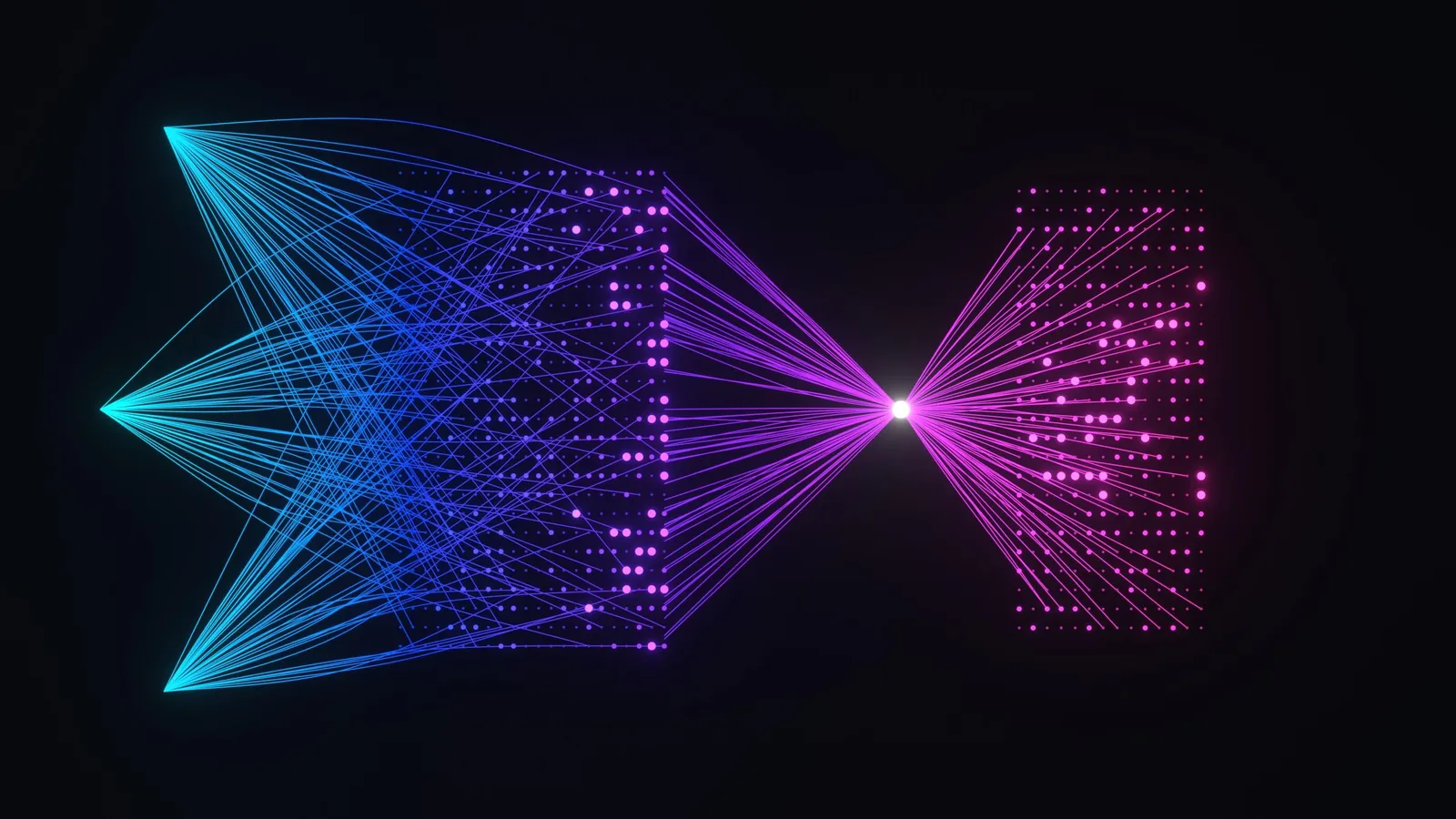
Many input lines converging to a single point, then fanning out into a grid of outcomes
Five pattern sources, per period
P1Ground-truth viewsP2Abstract dataP3Financial resultsP4Genre decayP5Behaviours

Not guessed.
Computed.

Derived from known data, held, and updated whenever its inputs change, like a formula in a spreadsheet. Pattern recognition from evidence, anchored in time.

Five glowing layers stacked one above the other
The technology stack

Five layers, one platform.

The foundation is the record: over 128,000 titles, 45 months and 202 sources of ground truth. Five layers sit on top of it.

  1. 01

    .API connect Multiple-level access

    An API suite with custom and industry-standard connectors.

  2. 02

    .security Offline vault

    Encrypted, and held offline in physical vault storage.

  3. 03

    .tem learners Fan-out learning

    Agents that speak many languages and adapt to cultures, seeking the best and latest practice in each discipline.

  4. 04

    .tem modules Domain-expert teams

    Teams of expert agents with access to Wyatt, generated automatically and developed through exams.

  5. 05

    .wyatt Orchestration

    Agentic reasoning, inference-time compute and multi-agent collaboration, using temporal periods to reason about the behaviour patterns that succeed.

Glowing chess pieces on a neon board under a field of stars
Why now

Chess was bounded too, and it fell to compute.

<12 GFLOPSDeep Blue, which beat Kasparov in 1997
3.9M GFLOPSOne NVIDIA H100 today (at FP8 precision)

Deep Blue never counted every game; it searched what mattered. So do we. Without time, behaviour is only pattern recognition. Anchoring it to when it happens makes it computable.

04 The proof

Read more inputs, and less is left to chance.

What looks like noise is often inputs not yet read. We test that two ways: with people, and at scale.

At scale · live 292.85B

Views computed in one industry.

Across 45 months, 20 markets and 34 platforms, anchored to published ground truth from 202 sources. This is the engine behind Oh Talent.

See it in Oh Talent
Observed · with people 92%vs 44% by chance

People read the same scene the same way.

In 300+ blind table-setting sessions, 92% of readings fell within two bands, against 44% by chance (95% confidence interval 88.4–94.6%).

Take the Table Test
Proved · mathematically inf R(S) = 0

With more inputs, the unexplained part falls to its floor.

The space of scenes is finite (Proposition 4.1), and adding inputs never raises the residual (Equation 30). What remains at the floor is measured per person, per period.

Demonstrated · computationally 0.00436falls to 0.00010, the noise floor

The residual falls to its noise floor.

As six inputs are added, the residual falls from 0.00436 to 0.00010. 168 computational checks, none failed.

Next · planned 5,000–10,000

Participants in a controlled study.

  1. Fit the transition on recorded scenes
  2. Fit weights for every participant segment
  3. Test on new scenes whether reading in time beats habit alone

Every test updates the equation, including the ones it fails. That is the VITAL principle: validity is not a certificate issued once. It is the state of the weights after every test so far, and it grows with each one.

05 Applications

One engine, many markets.

Film and TV came first: outcomes are published there, and most viewing numbers are not. The same stack now serves music, and the research reaches further.

New customer · music

Toy Soldiers runs on our audience science.

Toy Soldiers is a creator-owned, direct-to-fan music platform. Oh technology gives each artist a computed reading of their fans: who they are, what each segment wants, and which content brings them closer.

  1. Discover
  2. Subscribe
  3. Engage
  4. Transact
  5. Belong
−10…+10preference scale, across nine fan segments
250 msto answer each query
Our commitments

Influence is not justified because it is possible.

We read audiences. We never steer them against their interest.

  1. Consent first.No change to content without the owner’s permission.
  2. Read, don’t exploit.No loops built to hold people against their interest.
  3. Segments, not files.Audience data is read in segments, never as files on individual viewers.
  4. Count the participant.The cost of a change includes the cost to them.
  5. Scan for bias.A biased reading is an error, and it is tested for.
A glowing ring
Company

Oh technology Inc.

Privately held, and based in Los Angeles.

  • Roy TaylorChief Executive Officer

Contact

Email
support@oh.technology
Phone
+1 323 630 5266
Address
The Invention Room
Los Angeles, CA 90036

Investors and press: write to us for materials.

Go deeper